|
CAMBODIA
MAJOR ATTRACTIONS
Phnom Penh
Cambodia's
capital retains an undeniable charm despite the desperate and distressing
past. Phnom Penh offers the visitors everything: the past and the
present, the poverty and the excess, the East and the West.
Sitting
at the confluence of the Tonle Bassac and the Tonle Sap rivers,
for long Phnom Penh has been considered the loveliest cities of
Indochina. The crumbling colonial architecture makes some parts
of the city very European, while the several impressive wats here
and there confirm the truly traditional Khmer culture.
The
riverfront of Phnom Penh
lined with swaying palm, side walk cafés and restaurants is undoubtedly
the most splendid in Asia and should not be missed while you are
here. Other sites to be visited in town includes Wat Phnom, Wat
Ounalom, Wat Lang Ka, the Silver Pagoda, the Royal Palace,
and the National Museum. The Tuol Sleng Museum and the Killing Field
of Choeung Ek were the places the Khmer Rouge tortured and executed
about 17,000 victims during the genocide could also be on the itinerary.
All
in all, Phnom Penh is rising over all the destruction of the painful past, continuing
to be one of the most beautiful cities in Asia.
Phnom Penh therefore can also be the proof of the Khmers’ strength
and determination to build up their country back to glory. Please
think carefully about giving enough time for Phnom Penh on holidays,
otherwise one may regret
later.
Angkor
Temples
The
celebrated temples of Angkor are Cambodia's greatest tourist attraction.
The 100 or so temples are the sacred remains of what was once
a much larger administrative and religious centre, and were built
between the 9th and 13th centuries to glorify a succession of
Khmer kings. The three most magnificent temples are Bayon, Ta
Prohm and the immense Angkor Wat.
From
the 13th century, the Khmer empire went into decline.
The state religion reverting to Hinduism led to the vandalization,
or alteration of many Buddhist sculptures. Angkor was sacked by the Thais in 1351, and again in 1431. In the
15th century, the Khmer court moved to Phnom
Penh and only located back to SiemReap fleetingly in the 16th
century. Most of Angkor was abandoned in the 15th century to pilgrims
and holy men. The temples were gradually cloaked by forest.
Battambang
Cambodia's
second-largest city is an elegant riverside town, home to some of
the best-preserved colonial architecture in the country. Battambang
used to be off the map for travelers, but facilities have been improved
and it makes a great base for visiting the nearby temples and villages.
The
network of charming old French shop houses clustered along the riverbank
is the highlight of Battambang city, and there are a number of wats
scattered around the town. The small museum has a collection of
Angkorian-era artifacts, and beyond the town there are a number
of hilltop temples, yet more wats and a large lake. Battambang is
a pretty bumpy 293km (181mi) bus or share-taxi ride from the Phnom Penh.
Sihanoukville
Sihanoukville
is Cambodia's
leading beach resort. Besides, the nearby Ream National Park
and a dozen undeveloped off-shore islands make the city extremely
popular for the well-to-do Khmer from Phnom Penh. Four squeaky white
sand beaches ring the headland - Ochheuteal, Sokha, Independence
and Victory - and the fishing port offers the odd photo opportunity
at sunrise or sunset. There are a few dive operations in town, plus
a waterfall an hour's drive away. Sihanoukville is 232km (143mi)
from Phnom Penh, and is served by regular buses.
Kompong
Luong
Ten
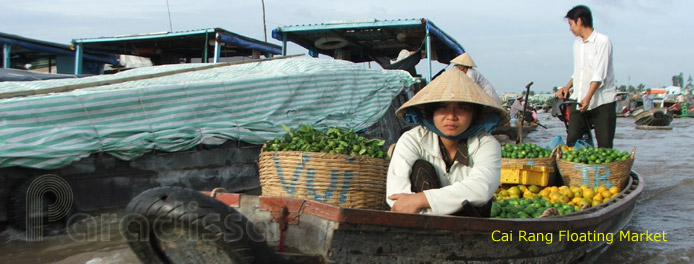
thousand people live in this permanently floating town on Tonlé
Sap lake. Houses, schools, karaoke bars and restaurants float atop
boat-based foundations, rising and falling with the tide. Like the Vietnamese Floating Village
on the northern stretch of the lake, the population is mainly Vietnamese.
There's not much to do, and nowhere to stay, so it's a matter of
soaking up the atmosphere of life on the water, with an iced coffee
or beer in hand. Kompong Luong is near the southern reaches of Tonlé Sap Lake
in Pursat province, around 40km (24mi) northeast of Pursat.
Phnom
Udong
Udong,
40km (25mi) north of Phnom Penh,
was the capital of Cambodia between 1618 and 1866. It's generally
very quiet here, and you'll often have the town's stupas to yourself
(along with picnickers at weekends). You'll find the ruins sprinkled
across two ridges.
Takeo
Takeo
town is 80 km South of Phnom Penh
along highway 5. Known as the “cradle of Cambodian civilization”,
Takeo province has several pre-Angkorian sites built between the
5th to the 8th centuries. Back to its heyday,
the principal center was at Angkor Borei, other smaller religious
centers at Phnom Chisor and Phnom Bayong. Today Takeo is mainly
a province of farming and fishing.
Kampot
Having
rich abandoned colonial legacy and abundant natural attractions,
Kampot province is emerging as one of the most popular provinces
for travelers in Cambodia. Kampot, the provincial capital town,
is a somnolent riverside town adorned with rich French colonial
architecture and tranquil atmosphere. Kampot town is a convenient
base for exploring Kep beach resort, the hill station of Bokor and
the caves around Kompong Trach.
Top
|