People & Population

The Kinh people at Saigon Vietnam
Most other groups inhabit mainly in the mountainous region including the H'mong, the Tay, the Thai, the Nung, the Dzao, the M'nong, the Ede, the Giarai...Each of them maintain a distinctive traditional culture; some live separately from the mainstream society. Cross-marriages are not common among the mountain dwellers.

A Tay lady at Hoang Su Phi - Ha Giang
According to the general census in 1999, the population of Vietnam includes Kinh (Viet) 86.2%, Tay 1.9%, Thai 1.7%, Muong 1.5%, Kh'me 1.4%, Hoa 1.1%, Nung 1.1%, Hmong 1%, others 4.1%.
Each ethnic group in Vietnam has a rich and complicated spiritual life including religions, ideology, cults and worshiping traditions, of which Buddhism accounts for 9.3% of the population, Catholicism 6.7%, Hoahaoism 1.5%, Caodaism 1.1%, Protestantism 0.5%, Muslim 0.1%. The population without an official religion accounts for 80.8% of the population (1999 census), though in reality those in this group may vary from lay people to polytheists, or practicing superstition...

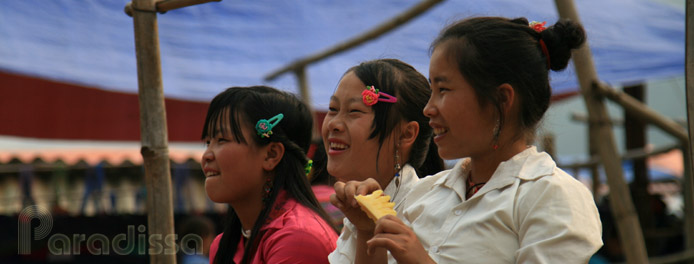
Nung ladies at Hoang Su Phi Market - Ha Giang - Vietnam
Vietnamese is the main language for all communities living in Vietnam. English, French and Chinese are taught in schools. English is getting more of a second language in day-to-day business transactions. Chinese is getting more and more people in the regions sharing the borders with China.

Ha Nhi People at Muong Hum, Lao Cai
Vietnam has a good system of education with nursery schools, primary schools, secondary schools, vocational schools, colleges and universities. Literacy rate in Vietnam is over 90%; primary education is compulsory and free. Still, the country would need much improvement in the quality of the system to catch up with those in developed countries.

A Red Dzao Lady at Sapa Vietnam
According to surveys in certain provinces of Vietnam in 2010, the country is in high risk of sex disparity due to fetal ultrasound and abortion: 155 male/100 female. Over 80% of the population live in rural areas and the rest in urban areas. Infant mortality is especially high in the mountainous regions.

Giay & Dzao Lady (to the right) at Muong Hum - Lao Cai
Vietnam is a young population country with over 65% of the population in the labor force (15 years of age to 64 years of age according to a 2006 estimate). With a good educational system and good macro-economic policies to utilize the labor force, there's a good chance for the country to become a real economic tiger in the region and the World.
Note: The statistics used in the articles were taken from the General Statistics Department of Vietnam.
Share your own |
3.26 Copyright (C) 2008 Compojoom.com / Copyright (C) 2007 Alain Georgette / Copyright (C) 2006 Frantisek Hliva. All rights reserved."
Vietnam Travel Guides
- Activities
- Arts & Entertainment
- Bac Kan
- Bac Lieu
- Bac Ninh
- Battlefields
- Ben Tre
- Buon Ma Thuot
- Ca Mau
- Can Tho
- Cao Bang
- Cat Ba Island
- Chau Doc
- Climate
- Con Dao Island
- Cu Chi Tunnel
- Da Lat
- Da Nang
- Dangers & Annoyances
- Economy
- Embassies & Consulates for Vietnam
- Embassies & Consulates of Vietnam
- Festivals & Events
- Food & Drinks
- Geography
- Gia Lai
- Ha Giang
- Ha Tay
- Halong Bay
- Hanoi
- Hau Giang
- Health
- History
- Ho Chi Minh City
- Hoa Binh Mai Chau
- Hoi An
- Hue
- Khanh Hoa
- Kien Giang
- Kon Tum
- Lang Son
- Languages
- Lao Cai
- Long Hai
- Mekong Delta
- Money & Banks
- My Son
- My Tho
- Nam Dinh
- National Parks
- Nha Trang
- Ninh Binh
- Ninh Thuan
- North East
- North West
- Overview
- Passports & Visas
- People & Population
- Perfume Pagoda
- Phan Thiet Mui Ne
- Phu Quoc Island
- Phu Tho
- Phu Yen
- Posts & Communications
- Quang Binh
- Quang Ngai
- Quang Ninh
- Quang Tri
- Quy Nhon
- Religion & Ideology
- Sapa
- Shopping
- Soc Trang
- Society & Conduct
- Son La
- State & Law
- Tay Ninh
- Thai Nguyen
- Thanh Hoa
- Tra Vinh
- Transport
- Travel Facts
- Tuyen Quang
- Vinh Long
- Vinh Phuc
- Vung Tau
- Yen Bai


PDF
Print
Send mail